
Sell Used & Scrap Car Parts for Cash in Toronto
EcoScrap.ca buys engines, transmissions, alternators, starters, radiators, AC condensers, rotors, exhaust, batteries and wiring from auto shops and car owners across the GTA and up to 200 km from Toronto. We pick up free, load it ourselves and pay cash on the spot.
Free Car Parts Quote
EcoScrap.ca buys used and scrap car parts from auto repair shops, dealerships, fleets and car owners across Toronto, the GTA and anywhere within 200 km of the city. We come to you with free pickup, load the parts ourselves and pay cash on the spot (or e-Transfer if you prefer). For today’s price, call (647) 915-5440.
Responsible recycling of scrap car parts is part of Ontario’s circular economy strategy, and the Canadian Association of Recycling Industries represents metal recyclers across the country.
If you run a garage, you know how fast the back corner fills up: a seized engine pulled last week, two transmissions that were replaced under warranty, a box of dead alternators and starters, a stack of rotors, cracked radiators, cut-off exhaust and a pallet of old batteries. Every one of those items has metal value — steel, cast iron, aluminum, copper and lead — but only if it gets to the right buyer without costing you a day of labour. That is the gap we fill. This page explains exactly what we buy, how each part is valued, how to prepare it, the difference between selling a part as a core and as scrap, and which cities we serve.
What Car Parts Does EcoScrap Buy?
We buy almost every metal component that comes off a car, light truck or van. If it is mostly metal and not hazardous waste on its own, chances are we take it. The main categories are:
- Engines and engine blocks — complete engines, long blocks, short blocks, bare blocks and cylinder heads, both cast iron and aluminum.
- Transmissions — automatic and manual, with aluminum cases (the most common today), plus transfer cases and differentials.
- Alternators and starters — valued for the copper windings inside the steel or aluminum housing.
- Radiators and AC condensers — aluminum radiators, older copper/brass radiators, AC condensers, heater cores and intercoolers.
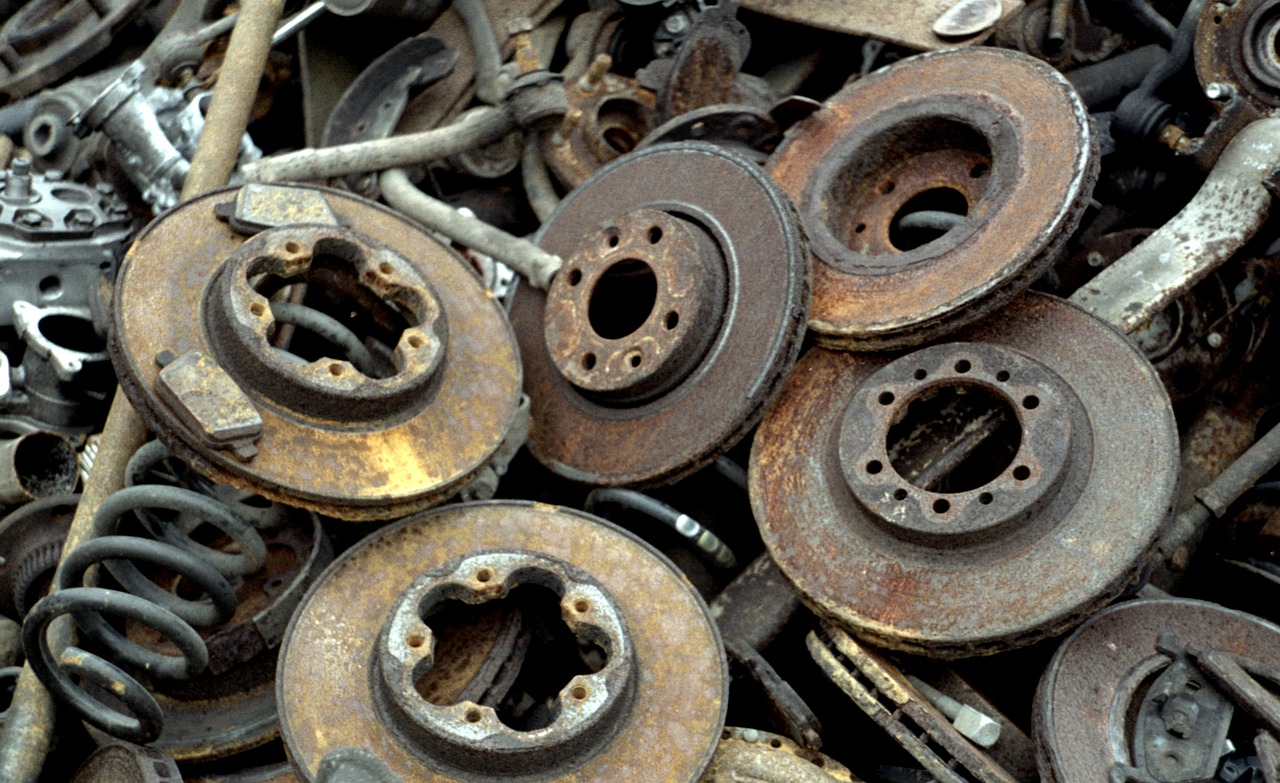
- Brake rotors and drums — cast iron rotors, drums and hubs (see our dedicated scrap metal pickup page for bulk iron).
- Mufflers and exhaust — steel pipes, mufflers, resonators and stainless sections. Catalytic converters are bought separately at a much higher value — see sell catalytic converters.
- Car batteries — lead-acid batteries from cars, trucks and equipment.
- Wiring harnesses — engine and body harnesses with copper conductors.
- Aluminum parts — control arms, knuckles, intake manifolds, oil pans, valve covers, bell housings and, of course, alloy rims and wheels.
- Whole vehicles — if the whole car is done, see cash for junk cars.
Not sure whether something counts? Describe it or text a photo when you call, and we will tell you whether we buy it and roughly how it is graded. You can also see everything we handle on our services page.
Scrap Car Parts at a Glance: Main Metal, Grade and What Affects Value
Each part is priced by its dominant metal and how “clean” it is — meaning how much other material is attached. Use this table as a quick guide. It is not a price list; prices follow the live metal markets and change week to week, so always call for today’s number.
| Part | Main metal(s) | How it is usually graded | What raises value | What lowers value |
|---|---|---|---|---|
| Engine / block | Cast iron or aluminum (block), steel, aluminum heads | Complete engine, or aluminum vs iron block | Aluminum block and heads; drained of fluids | Oil and coolant left in; lots of plastic and wiring attached |
| Transmission | Aluminum case, steel gears | Aluminum transmission (with internals) | Drained; no steel bell or cooler lines attached | Fluid left inside; mixed with non-metal debris |
| Alternator | Copper windings, steel or aluminum shell | Alternators / “electric motors” | Kept separate from steel | Mixed into general steel bin |
| Starter | Copper windings, steel housing | Starters / electric motors | Kept separate; dry | Mixed into general steel |
| Radiator (aluminum) | Aluminum core, plastic tanks | Aluminum radiator (with or without tanks) | Plastic tanks removed; drained | Steel brackets and fans attached |
| Radiator (copper/brass) | Copper core, yellow brass tanks | Copper/brass radiator | Clean, no steel frame | Steel side rails left on |
| AC condenser | Aluminum, sometimes copper tubes | Aluminum or Al/Cu radiator | Refrigerant properly recovered; no steel | Steel mounting brackets |
| Rotor / drum | Cast iron | Cast iron / heavy steel | Bulk quantity, no aluminum hubs | Mixed with light tin |
| Muffler / exhaust | Steel, some stainless | Light or mixed steel; stainless separated | Cat converter cut off and sold separately | Cat converter left on the pipe and sold as steel |
| Battery | Lead, acid, plastic case | Lead-acid batteries | Intact case, upright, no leaks | Cracked, leaking cases |
| Wiring harness | Copper wire, plastic insulation | Insulated copper / harness wire | Connectors and plastic trimmed back | Heavy plastic conduit and steel clips |
| Aluminum parts | Cast aluminum (e.g. A356 for wheels) | Cast aluminum / alloy wheels | Steel bolts, bushings and ball joints removed | Rubber, steel and dirt attached |
Engines and Engine Blocks: What Are They Worth as Scrap?
Engines are the heaviest single item most shops get rid of, and they are also the most variable in value. A complete engine is mostly cast iron or aluminum, with steel cranks and cams, aluminum or iron cylinder heads, and smaller amounts of copper in sensors and wiring. Many modern four- and six-cylinder engines use aluminum blocks and heads, while older V8s and many truck and diesel engines are cast iron.
Aluminum block vs cast iron block
Aluminum is worth considerably more per kilogram than iron, so an all-aluminum engine is usually the more valuable scrap item even though it weighs less. A cast iron block is graded more like heavy steel. When you call, tell us the make, model and engine size if you know it — that alone tells us most of what we need to quote it.
Complete engine vs stripped block
You do not need to strip an engine before we pick it up. Shops are busy, and pulling every accessory is rarely worth the labour. That said, if you have already removed the alternator, starter, AC compressor and wiring, keep those separate: they are graded on their own and often add up to more than leaving them on the block.
- Drain the oil and coolant — fluid-filled engines are harder to handle and are priced lower.
- Plug or cap open ports if the engine is sitting outside, so it does not fill with rainwater.
- Leave it on a pallet or engine stand if you can; it makes loading faster for everyone.
- Tell us if it is a running take-out. A good used engine may be worth more as a part than as scrap — we will be honest with you about which route makes sense.
Transmissions with Aluminum Cases
Almost every modern automatic and manual transmission uses an aluminum case, with steel gears, shafts, clutch packs and valve bodies inside. In the scrap trade these are graded as “aluminum transmissions,” a category of its own that is priced between clean cast aluminum and mixed steel. Transfer cases and many differential housings fall into similar categories.
The key to getting the better grade is to keep it a transmission and not a mixed lump of metal. Remove any steel bell housing adapters or crossmember pieces if they are still bolted on, drain the ATF or gear oil, and do not leave a torque converter full of fluid sitting inside the bell. Warranty swaps, rebuild cores that will never be sent back and failed CVTs all qualify. If you have a large number of transmissions from a busy drivetrain shop, ask about a regular pickup schedule.
Alternators and Starters: Why the Copper Matters
Alternators and starters look like small steel lumps, but inside each one are copper windings — the stator in an alternator and the field windings and armature in a starter. That copper is why recyclers grade them separately from general steel, usually under a category called “electric motors” or “alternators and starters.” Mixing them into your steel bin is one of the most common ways shops leave money on the table.
Keep a dedicated bin or drum for them. They do not need to be cleaned or taken apart, just kept dry and separate. Some shops also include AC compressors, power steering pumps with electric motors, blower motors and window motors in the same bin; tell us what is in there and we will sort out the grading on site.
Radiators, AC Condensers and Heater Cores
Radiators come in two main types. Most cars built in the last few decades use an aluminum core with plastic end tanks. Older vehicles, heavy trucks and some equipment still use copper/brass radiators — copper tubes and fins with yellow brass tanks — which are worth significantly more per kilogram. AC condensers are typically all aluminum, and some intercoolers and heater cores are aluminum or copper/brass too.
- Aluminum radiators: worth more if the plastic tanks are snapped off, but most shops leave them on — that is fine, we grade accordingly.
- Copper/brass radiators: keep them separate. Cut off any steel side rails or brackets if you have the time.
- AC condensers and evaporators: refrigerant must be recovered by a licensed technician before the system is opened, as required under Ontario and federal rules. We buy the condenser after recovery.
- Drain the coolant into your normal recycling stream; do not leave radiators full.
Bay full of radiators, alternators and old engines? We’ll clear it out.
Free pickup within 200 km of Toronto · Cash paid on the spot
📞 Call (647) 915-5440 NowBrake Rotors and Drums
Rotors and drums are cast iron, and in volume they are one of the steadiest scrap streams for any brake or general repair shop. Cast iron is a heavier, denser grade than light sheet steel, so keeping your rotors in their own bin or pallet usually gets a better price than mixing them with exhaust pipe and body panels. Hubs with aluminum components and rotors with wheel bearings still attached can be included — just let us know so we grade them correctly.
For shops that turn a lot of brakes — fleet maintenance, tire shops, quick-lube centres — a scheduled pickup every few weeks keeps the yard clear. You can read more about how our scrap program for mechanic, tire and muffler shops works.
Mufflers and Exhaust Systems
Exhaust pipe, mufflers and resonators are mostly steel, often with aluminized coatings, and some performance and newer OEM systems include stainless steel. On their own they are a lower-value grade, but they add up quickly at a muffler shop. The important rule: cut off the catalytic converter before you sell the rest as steel. The converter contains platinum, palladium and rhodium and is priced as a completely separate item — often worth far more than the rest of the exhaust combined. See our guide to catalytic converter scrap value in Ontario.
Stainless steel exhaust sections can be kept apart from regular steel. Many grades of stainless are non-magnetic or only weakly magnetic, so a magnet test is a quick way to sort them.
Car Batteries
Lead-acid batteries are one of the most recycled products in Canada. The lead plates and grids are recovered and the plastic case is recycled too. We buy car, truck, motorcycle and equipment batteries. Because they contain sulphuric acid, a few handling rules apply:
- Store and transport them upright.
- Do not stack them more than a couple high without pallets or cardboard between layers.
- Keep cracked or leaking batteries separate and tell us about them in advance.
- Do not drain the acid yourself.
Lithium-ion and hybrid/EV battery packs are a different category with different safety rules. Call us before setting one aside so we can tell you whether we can take it.
Wiring Harnesses
Engine and body harnesses are copper wire wrapped in plastic insulation, connectors, tape and conduit. They are graded as insulated copper or harness wire, and the recovery rate (how much of the weight is copper) drives the price. A harness with heavy plastic conduit and lots of connectors has a lower copper yield than one with bare-ish runs of wire. You do not need to strip the insulation — in fact, burning wire to remove insulation is illegal in Ontario and harmful to health. Simply cut off big plastic pieces and steel clips if you have a minute, and bag or box the harnesses separately. Heavy battery cables can also go in this bin, or with your other copper and brass scrap.
Aluminum Parts: Control Arms, Knuckles, Intakes, Wheels and More
Modern vehicles use a lot of cast aluminum to save weight. Suspension control arms, steering knuckles, intake manifolds, oil pans, timing covers, valve covers and bell housings are often aluminum. Clean cast aluminum — with steel bolts, bushings, ball joints and studs removed — is worth more than “dirty” aluminum with steel attached. Alloy wheels are their own premium grade, usually made from A356 aluminum alloy; learn more on our scrap alloy rims and wheels page and in scrap rim prices: aluminum vs steel.
A quick magnet test tells you a lot: if the magnet sticks, there is steel in it. If it does not stick and the part is light and grey or silver, it is probably aluminum.
Core vs Scrap: Which Way Should You Sell a Part?
Before you sell anything as scrap, ask whether it has core value. A “core” is a used part returned to a supplier or remanufacturer so it can be rebuilt. Alternators, starters, AC compressors, brake calipers, transmissions, turbochargers, steering racks and some engines often carry a core charge that you get back when you return the old unit to the parts supplier.
| Question | Sell as a core | Sell as scrap |
|---|---|---|
| Did you pay a core charge on the new part? | Yes — return it to the supplier for the refund first | No core charge, or the return window has passed |
| Is the unit complete and not broken? | Usually required for core credit | Broken, cracked, burnt or incomplete is fine |
| Is it a rebuildable type? | Common rebuild items (alternators, starters, calipers, racks) | Non-rebuildable or obsolete parts |
| How much handling do you want? | Paperwork, boxes, shipping back to supplier | One pickup for everything, cash on the spot |
| Volume | Individual units tracked one by one | Mixed bins, pallets and loose piles |
Our honest advice: if you are owed a core refund, take it — it is usually worth more than scrap value for that unit. Everything else — rejected cores, parts with no core program, units from vehicles you scrapped, and the backlog nobody had time to return — is what we are here for.
How to Prepare Parts: Draining Fluids and Sorting
Good preparation makes pickups faster, keeps your yard compliant and gets you a better grade. You do not have to do all of this, but each step helps.
- Drain fluids. Engine oil, transmission fluid, gear oil, coolant and fuel should be drained into your normal used-oil and antifreeze recycling. Fluids left in parts are an environmental and spill risk and lower the value.
- Recover refrigerant from AC systems through a certified technician before removing compressors, condensers or evaporators.
- Remove the catalytic converter from exhaust and sell it separately.
- Separate by metal: aluminum, cast iron (rotors, drums), steel (exhaust, brackets), copper-bearing (alternators, starters, harnesses), radiators, and batteries.
- Keep batteries upright on a pallet, away from the other scrap.
- Stack heavy items on pallets — engines, transmissions and rotors — so they can be loaded quickly.
- Note the rough quantity (for example “3 engines, 5 transmissions, two bins of rotors”) so we can bring the right truck.
How Selling Scrap Car Parts to EcoScrap Works
- Call (647) 915-5440 and tell us what you have, roughly how much, and where you are. Photos help.
- Get a quote based on today’s metal markets and the grade of each item.
- Book a pickup. In Toronto and the inner GTA, same-day or next-day pickup is often available. Farther out, we schedule you on the next route through your area.
- We arrive and load. Our crew does the lifting. You do not need to move anything to the curb.
- We sort, weigh and confirm the price with you before anything leaves your property.
- You get paid on the spot in cash, or by e-Transfer if you prefer.
We ask every seller for valid government-issued photo ID and keep a record of the transaction. That is part of buying responsibly: we do not buy stolen parts, and the paperwork protects legitimate shops as much as it deters the wrong kind of seller. For whole vehicles, the Ontario vehicle ownership permit must be signed over to us.
Get today’s price for your used car parts — free pickup.
Free pickup within 200 km of Toronto · Cash paid on the spot
📞 Call (647) 915-5440 NowWho We Buy Used and Scrap Car Parts From
- Mechanic and general auto repair shops — engines, transmissions, alternators, starters, rotors and everything else from daily repair work.
- Tire shops — rims, wheels, rotors, drums and wheel weights.
- Muffler and exhaust shops — exhaust pipe, mufflers, stainless sections and catalytic converters.
- Body shops and collision centres — radiators, condensers, aluminum suspension parts, bumper reinforcements and damaged wheels.
- Dealership service departments — warranty take-offs, take-out engines and transmissions, batteries.
- Fleet operators — delivery, taxi, municipal and contractor fleets with ongoing maintenance scrap.
- Private car owners and DIYers — a garage full of parts from a project car, or one old engine you need gone.
Shops with steady volume can set up a recurring schedule so the scrap never piles up. Read about our scrap program for mechanic, tire and muffler shops for details.
Why Sell Your Scrap Car Parts to EcoScrap?
- We come to you. Free pickup anywhere within 200 km of Toronto — no trailer rental, no trip to the scrapyard, no waiting in line at the scale.
- We do the loading. Engines, transmissions and pallets of rotors are heavy. Our crew handles them so your techs stay on billable work.
- Cash on the spot. You are paid before we drive away, or by e-Transfer if that is easier for your bookkeeping.
- Fair, transparent grading. We explain how each item is graded and why, so you know what affects your price next time.
- One pickup for everything. Parts, catalytic converters, rims, copper, brass and mixed metal — even junk cars — in a single visit.
- Responsible buying. ID and transaction records on every purchase; we do not buy stolen parts.
- Fast scheduling. Same-day pickup is often available across Toronto and the inner GTA.
Tips to Get More Money for Used Car Parts
- Separate by metal. A bin of mixed scrap is graded at the lowest common denominator. Separate aluminum, cast iron, copper-bearing parts, radiators and batteries.
- Cut off the catalytic converter and sell it on its own.
- Claim core refunds first where you have them; scrap the rest.
- Drain all fluids. Dry parts are cleaner, safer and grade better.
- Remove steel from aluminum where it takes seconds — bolts, studs and brackets.
- Keep alternators and starters out of the steel bin. Their copper is worth paying for.
- Pull plastic tanks off aluminum radiators if you have a slow afternoon.
- Build volume. A full load is more efficient to collect, especially outside the GTA. Store parts neatly until you have a good quantity, then call.
- Ask about timing. Metal prices move with world markets. We cannot predict them, but we can tell you today’s price whenever you call.
Cities We Serve: Free Car Parts Pickup Within 200 km of Toronto
We collect used and scrap car parts across the Greater Toronto Area, the Golden Horseshoe and southern Ontario, up to about 200 km from downtown Toronto. For a full breakdown with approximate distances and how scheduling works farther out, read free scrap pickup within 200 km of Toronto.
Toronto and the inner GTA
Toronto, Etobicoke, North York and Scarborough — including the auto-shop clusters along the 401, 427 and 400 corridors.
Peel and Halton
Mississauga, Brampton, Oakville, Burlington and Milton, plus Caledon, Bolton, Georgetown and Halton Hills.
York Region
Vaughan, Markham, Richmond Hill, Newmarket and Aurora, plus King City and Stouffville.
Durham Region
Ajax, Pickering, Whitby and Oshawa, plus Bowmanville, Clarington and Uxbridge.
Hamilton, Niagara and Brant
Hamilton, St. Catharines and Brantford, plus Stoney Creek, Grimsby, Niagara Falls and Welland.
Waterloo Region, Wellington and beyond
Kitchener, Cambridge, Guelph and Waterloo, plus Fergus, Woodstock, Stratford and out to London.
Simcoe County and the Kawarthas
Barrie and Peterborough, plus Innisfil, Bradford, Alliston, Orillia, Collingwood, Lindsay, Port Hope and Cobourg.
Not on the list? If you are within roughly 200 km of Toronto, call (647) 915-5440 and we will confirm.
Paperwork, ID and Rules You Should Know
This is general information, not legal advice. Scrap buying in Ontario is a regulated, record-keeping business, and some municipalities have their own by-laws for second-hand and salvage dealers. Here is what to expect when you sell parts to us:
- Valid government photo ID is required for every transaction.
- Catalytic converters are recorded with extra detail, because they are a common target for theft. Shops should be able to tell us the vehicle the converter came from.
- Whole vehicles require the ownership permit signed over to us. Keep your plates and cancel your insurance after the sale — see how to sell a junk car in Ontario.
- Hazardous fluids (oil, coolant, fuel, refrigerant) should be drained or recovered through your normal licensed channels before pickup.
- Stolen parts — we will not buy them, and we cooperate with lawful requests from authorities.
Call now for free pickup and cash for your scrap car parts.
Free pickup within 200 km of Toronto · Cash paid on the spot
📞 Call (647) 915-5440 NowFrequently Asked Questions About Selling Scrap Car Parts in Toronto
Do you buy used car parts in Toronto for cash?
Yes. EcoScrap.ca buys used and scrap car parts across Toronto and within 200 km, picks them up free and pays cash on the spot or by e-Transfer. Call (647) 915-5440.
What car parts are worth the most as scrap?
Catalytic converters are by far the most valuable because of platinum, palladium and rhodium. After that, aluminum parts and wheels, copper/brass radiators, alternators and starters, and aluminum transmissions usually beat plain steel per kilogram.
Do I need to drain the fluids first?
Yes, please drain oil, transmission fluid, coolant and fuel into your normal recycling stream. Dry parts are safer to move and grade better. AC refrigerant must be recovered by a certified technician.
Can I sell an engine with the accessories still on?
Yes. A complete engine is fine. If you have already removed the alternator, starter or AC compressor, keep them separate because they are graded on their own.
How do you price scrap car parts?
By the main metal, the grade, how clean the part is and the weight, based on live metal markets that day. We do not publish fixed prices because they change. Call for today’s price.
Should I return a part for its core charge or sell it to you?
If you are owed a core refund from your parts supplier, return it first — that is usually worth more. Sell us everything that has no core value or was rejected as a core.
Is there a minimum amount for pickup?
In Toronto and the inner GTA, we pick up most reasonable loads. Farther from the city, we group pickups on route days, so a larger load helps. Call to confirm what works for your location.
Do you buy car batteries?
Yes, we buy lead-acid car, truck and equipment batteries. Keep them upright and tell us about any that are cracked or leaking. Call ahead about lithium-ion or EV packs.
What ID do I need?
A valid government-issued photo ID. We record every transaction, with extra detail for catalytic converters. For a whole car, you need the ownership permit signed over.
How fast can you pick up?
Same-day or next-day pickup is often available in Toronto and the inner GTA. Farther away, we book you on the next route through your area.
Do you pick up from private homes, not just shops?
Yes. Private owners with an engine, a set of rims or a garage full of parts can call us too.
Which cities do you serve?
Toronto, Peel, York, Durham, Halton, Hamilton, Niagara, Waterloo Region, Guelph, Barrie, Peterborough, Brantford, London and everywhere else within about 200 km of Toronto.
Turn Your Used & Scrap Car Parts into Cash Today
Free pickup from Toronto auto shops and anywhere within 200 km. We load it, weigh it and pay cash on the spot.