
Sell Catalytic Converters for Cash in Toronto & Ontario – Free Pickup Within 200 km
EcoScrap.ca buys used, scrap and cut-off catalytic converters from muffler and exhaust shops, mechanics, dealerships and car owners. We grade every unit by its code and condition, price it against today's platinum, palladium and rhodium market, pick up free anywhere within 200 km of Toronto and pay cash on the spot.
Free Catalytic Converter Quote
EcoScrap.ca buys catalytic converters from muffler shops, mechanics, dealerships, fleets and private car owners across the GTA and anywhere within 200 km of Toronto. We pick up for free, grade each converter by its OEM code and condition, and pay cash on the spot (or e-Transfer if you prefer). Call (647) 915-5440 for today’s price.
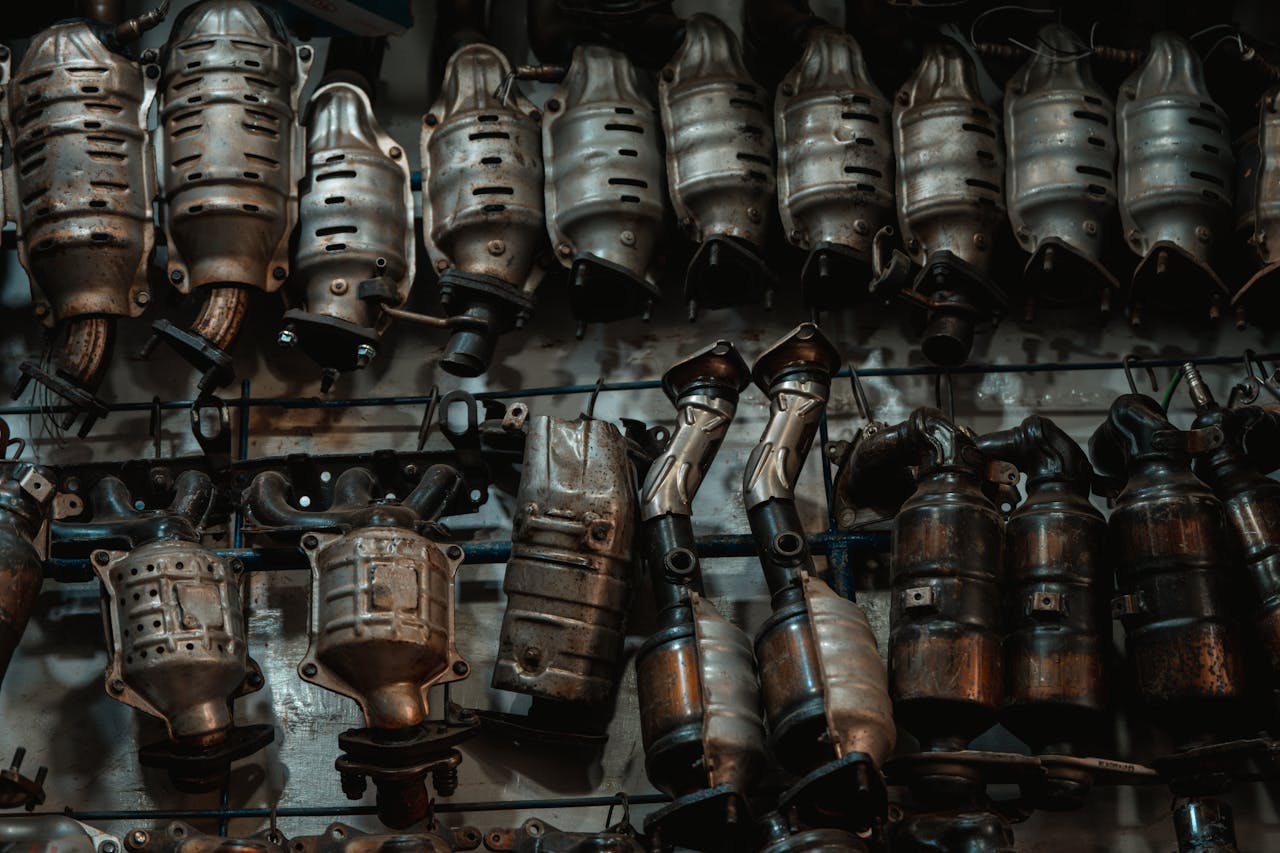
Catalytic converter value comes from the platinum, palladium and rhodium inside (learn how a catalytic converter works), and Canada’s recycling sector is represented by the Canadian Association of Recycling Industries.
If you are looking to sell catalytic converters in Toronto, you have probably noticed that prices are all over the place. One buyer quotes a flat number per piece, another wants you to drive across town, and a third will not tell you anything until they see the unit. This page explains, in plain language, exactly how catalytic converter value works, what we look for when we grade a converter, and how our free pickup and cash payment process works for shops and individual sellers in Ontario.
Converters are the single most valuable scrap item on most vehicles, because the ceramic or metal core inside is coated with tiny amounts of platinum group metals (PGMs). Those metals are refined and reused, which is why catalytic converter recycling in Ontario is both a real business and a meaningful environmental win. Our job is to give you a fair, transparent price for that material and to make selling it as easy as one phone call.
What Catalytic Converters Does EcoScrap Buy?
We buy almost every type of automotive catalytic converter, whether it is still welded into an exhaust section, cut off with pipe attached, or loose. We regularly pick up:
- OEM (factory) converters from cars, SUVs, minivans and light trucks — domestic, Japanese, Korean and European makes.
- Aftermarket converters — the universal or direct-fit replacements installed by exhaust shops.
- Pre-cats and manifold converters — the small units built into or bolted directly to the exhaust manifold.
- Dual and multi-brick converters from V6 and V8 engines and larger vehicles.
- Diesel aftertreatment units — diesel oxidation catalysts (DOC), diesel particulate filters (DPF) and, in some cases, combined DOC/DPF assemblies from pickups, vans and light commercial vehicles.
- Hybrid vehicle converters, which often carry heavier precious metal loadings.
- Damaged converters — dented shells, rattling cores, cracked or partially missing honeycomb (priced on what is still inside).
- Bulk lots from muffler and exhaust shops, auto repair shops, dealerships’ service departments, fleet garages and auto recyclers.
If you are not sure what you have, that is fine. Read us the stamped code over the phone, send a photo, or simply tell us the year, make and model the converter came off. We also buy the rest of your exhaust scrap — mufflers, pipes and resonators — along with other metals and parts. See our used and scrap car parts page and our scrap metal pickup service for the full list.
What Is Inside a Catalytic Converter That Makes It Valuable?
A catalytic converter is a stainless steel shell that holds a substrate — usually a ceramic honeycomb called a monolith, or on some vehicles a corrugated metal foil core. That honeycomb is coated with a “washcoat” carrying microscopic amounts of three precious metals:
Platinum (Pt)
Platinum is the classic catalyst metal. It is especially common in diesel oxidation catalysts and in many older gasoline converters. It helps convert carbon monoxide and unburned hydrocarbons into carbon dioxide and water.
Palladium (Pd)
Palladium does a similar oxidizing job and became the dominant metal in most modern gasoline converters. Because so many late-model gas vehicles use palladium-heavy formulas, palladium prices have a big influence on what a typical car converter is worth.
Rhodium (Rh)
Rhodium is the reduction catalyst that breaks down nitrogen oxides (NOx). It is used in very small quantities, but it is one of the most expensive metals in the world per ounce, so even a fraction of a gram can make a noticeable difference to a converter’s value.
The total precious metal content in a single converter is measured in grams — sometimes only a few grams — and it varies widely from one model to another. A buyer cannot see those metals with the naked eye. That is why serious buyers rely on reference codes, assay data and grading experience, not just the size or look of the shell.
| Metal | Main job in the converter | Where it is most common | Effect on scrap value |
|---|---|---|---|
| Platinum (Pt) | Oxidizes CO and hydrocarbons | Diesel DOCs, many older gas units | High; tracks the platinum market |
| Palladium (Pd) | Oxidizes CO and hydrocarbons | Most modern gasoline converters | Major driver for typical car converters |
| Rhodium (Rh) | Reduces nitrogen oxides (NOx) | Three-way gasoline converters | Small amounts, very high price per gram |
| Substrate (ceramic or foil) | Carries the coated washcoat | All converters | No metal = little value beyond the steel shell |
| Stainless steel shell | Holds and protects the core | All converters | Minor value as scrap steel |
OEM vs Aftermarket Catalytic Converters: Why the Price Is So Different
The single biggest question we get from car owners is why their converter was worth far less than a neighbour’s. Most of the time, the answer is OEM versus aftermarket.
OEM (original equipment) converters
OEM converters are installed at the factory by the vehicle manufacturer. They are engineered to meet emissions standards for the full life of the vehicle, so they are typically loaded with more platinum, palladium and rhodium. They usually carry a manufacturer part number or code stamped or etched on the shell or heat shield. These are the converters that bring the strongest prices.
Aftermarket converters
Aftermarket converters are replacement units installed after the original failed or was removed. They are built to a lower price point and usually contain much less precious metal. Many have a brand name and a generic part number, a thinner shell and a smaller brick. Aftermarket converters still have value — we buy them every day — but they are priced in a lower band.
How to tell the difference
- Look for a stamped manufacturer code — OEM units often show a code from the carmaker (for example a GM, Toyota, Honda, Ford or Chrysler/Stellantis part number) on the shell or heat shield.
- Check the welds and shell — aftermarket units often have visible seam welds, a shiny new-looking shell and a generic shape.
- Check the brand stamp — names of aftermarket exhaust brands usually mean aftermarket.
- Think about the vehicle’s history — if the exhaust was ever replaced at a muffler shop, there is a good chance the converter is aftermarket.
| Feature | OEM converter | Aftermarket converter |
|---|---|---|
| Installed by | Vehicle manufacturer at the factory | Repair or exhaust shop after the fact |
| Typical PGM loading | Higher | Lower |
| Identifying marks | Carmaker part number / code | Aftermarket brand name, generic number |
| Shell and build | Heavy shell, model-specific shape | Lighter shell, often universal shape |
| Relative scrap value | Higher — priced by code | Lower — priced by size and type |
| How we price it | Code lookup + condition | Category grading + condition |
Got OEM or aftermarket converters? Get today's price.
Free pickup within 200 km of Toronto · Cash paid on the spot
📞 Call (647) 915-5440 NowHow Is Catalytic Converter Value Determined?
No honest buyer can give you a single fixed price for “a catalytic converter”. Value depends on a handful of factors, and understanding them is the best way to make sure you get paid fairly. (For a deeper explanation, read our guide on catalytic converter scrap value in Ontario.)
1. Serial number or OEM code
The stamped code is the most important piece of information. Each code corresponds to a specific converter design, and that design has a known, typical precious metal content based on industry assay data. When we can read the code, we can price the unit with much more confidence — and usually more money for you. If the code has rusted off or been ground away, we fall back on category grading.
2. Size and number of bricks
Bigger is not automatically better, but in general a larger converter, or a unit with two or more internal bricks, holds more coated substrate. Dual converters from V8 trucks, large SUV units and some European converters tend to sit higher than small compact-car units. Small pre-cats can be surprisingly valuable because they work hard and are often heavily loaded.
3. Honeycomb (substrate) condition
The precious metals live on the honeycomb, so a converter with a full, intact core is worth the most. A converter that rattles has a broken core; it still has value as long as the pieces are inside. A converter that is empty, hollowed out or “gutted” is worth only its steel. Partially missing honeycomb is priced on the estimated percentage remaining. Melted or glazed cores, from engines that ran rich or misfired, may still be valuable but are graded case by case.
4. Ceramic vs metallic foil substrate
Most car converters use a ceramic honeycomb, which is what refiners process most efficiently. Some performance and European vehicles use a metallic foil core. Foil converters still contain PGMs, but they are harder to process and are generally priced differently. We will tell you which type you have and how that affects the number.
5. Diesel units: DOC, DPF and SCR
Diesel exhaust systems contain several components. The diesel oxidation catalyst (DOC) is usually platinum-coated and carries the most value. The diesel particulate filter (DPF) traps soot and may have a light precious metal coating — some DPFs are worth very little on their own, while combined DOC/DPF assemblies can be worth more. SCR units (used with diesel exhaust fluid) typically contain little or no precious metal. Diesel units are graded individually.
6. Live platinum, palladium and rhodium prices
Catalytic converter prices follow the global PGM markets, which can move noticeably from week to week. That is why we never publish a fixed price list. We quote based on the market at the time you call and confirm the final number when we see your converters. Call (647) 915-5440 for today’s price.
| Value factor | What raises the price | What lowers the price |
|---|---|---|
| OEM code | Readable carmaker code | Code missing, ground off or unreadable |
| Type | OEM, hybrid, pre-cat, heavy diesel DOC | Aftermarket / universal units |
| Size | Large or multi-brick units | Small, single-brick economy units |
| Core condition | Full, intact honeycomb | Empty, gutted or missing core |
| Substrate | Ceramic honeycomb | Metallic foil (priced differently) |
| Market | Rising Pt / Pd / Rh prices | Falling Pt / Pd / Rh prices |
| Quantity | Bulk lots from shops | One-off units with no code |
How EcoScrap Grades Your Catalytic Converters
Grading is simply the process of sorting converters into groups that share a similar expected metal content. Here is how we do it, step by step, so you know exactly what is happening when our driver looks over your converters:
- Identify the type. We first confirm whether each unit is OEM, aftermarket, a pre-cat, a diesel DOC/DPF or a foil-core unit.
- Read the code. If an OEM code is visible, we match it against reference data to see the typical value for that design.
- Check the core. We look into the inlet and outlet ends to confirm the honeycomb is present and assess how much of it is intact.
- Note size and brick count. For units without a readable code, size, shape and number of bricks help us place them in the right category.
- Apply today’s market. The grade is priced against current platinum, palladium and rhodium markets.
- Show you the breakdown. For bulk lots we can go through the grades with you unit by unit, so you can see where each piece landed and why.
We would rather explain our number than ask you to take it on faith. If you ever have a question about why a converter was graded the way it was, just ask — we will show you.
How to Sell Catalytic Converters in Toronto: How It Works
Selling to EcoScrap takes one phone call. There is no need to load converters into your car or wait in line at a scrapyard.
- Call (647) 915-5440. Tell us how many converters you have, whether they are OEM or aftermarket, any codes you can read, and where you are located.
- Get a free quote. For coded units we can often price them over the phone. For mixed bulk lots, we give you a range and confirm on site.
- Book your pickup. We come to your shop, driveway or yard anywhere within 200 km of Toronto. Same-day pickup is often available in the GTA.
- We grade on site. Our driver checks each unit, confirms the grade and walks you through the final number.
- Show your ID. We record the transaction with your valid government-issued photo ID, as responsible buyers do.
- Get paid on the spot. Cash in hand when we load up, or Interac e-Transfer if you prefer. We do the lifting and loading.
Ready to sell? We come to you and pay on the spot.
Free pickup within 200 km of Toronto · Cash paid on the spot
📞 Call (647) 915-5440 NowWho We Buy Catalytic Converters From
Most of the converters we buy come from businesses that replace them as part of everyday repairs. We also buy from private owners with legitimate, documented converters.
- Muffler and exhaust shops — the biggest source of used OEM converters, removed during exhaust replacements.
- Mechanics and auto repair shops — converters replaced for failed emissions tests, check-engine codes or physical damage.
- Dealerships’ service departments — warranty and customer-pay converter replacements.
- Fleet operators — vans, pickups and light-duty diesel units from fleet maintenance.
- Body shops and tire shops — converters and exhaust sections pulled during collision or undercarriage repairs.
- Private car owners — owners who have had their own converter replaced and kept the old one, or who are scrapping a vehicle. If you are scrapping the whole car, see our cash for junk cars page; the converter is part of what we pay for.
Bulk Catalytic Converter Program for Muffler Shops & Mechanics
If your shop pulls converters every week, a regular pickup schedule saves time and makes sure your scrap is turned into cash instead of collecting in a corner. Our scrap program for mechanic, tire and muffler shops is built around how working shops actually operate.
What the shop program includes
- Scheduled or on-call pickups — weekly, bi-weekly, monthly, or whenever your bin is full.
- Unit-by-unit grading — every converter graded on its own code and condition, not lumped into one average price.
- Clear breakdown — we walk you through what was picked up, how each unit was graded and what you were paid.
- Cash or e-Transfer payment — paid at pickup, with e-Transfer to the business if you prefer cleaner records.
- One stop for all your scrap — we also take scrap alloy rims and wheels, brake rotors and drums, mufflers, batteries, radiators, AC condensers, copper and aluminum on the same trip.
How shops can increase the value of each pickup
- Keep converters dry and stored indoors so codes do not rust off.
- Keep OEM and aftermarket units in separate bins — it speeds up grading.
- Cut converters off with a little pipe on each side rather than cutting through the shell.
- Never knock out or remove the honeycomb; it is where the value is.
- Note the year, make and model on the unit with a paint marker when the code is hard to read.
Shops anywhere in the GTA, Peel, York, Durham, Halton, Hamilton, Niagara, Simcoe County or Waterloo Region can set up a recurring pickup. Call (647) 915-5440 to get started.
ID, Records and Legitimacy: Why We Ask for Photo ID
Catalytic converter theft has been a real problem in Ontario, and responsible buyers take it seriously. EcoScrap does not buy stolen parts, and our process is designed to keep it that way.
- Valid government photo ID is required for every catalytic converter sale — a driver’s licence or other government-issued photo ID.
- We record every converter transaction, including who sold it and what was sold.
- Shops should have converters that came off customer vehicles in the normal course of repairs; a business name and contact are recorded with the sale.
- Private sellers should be able to explain where the converter came from — for example, a replacement receipt or the vehicle it was removed from.
- We will decline any sale that does not make sense, such as freshly cut converters with no explanation or sellers unwilling to show ID.
This is not legal advice, and rules can change, but in general you should expect any legitimate catalytic converter buyer in Ontario to ask for identification and keep records. If a buyer does not, that is a red flag. Our goal is simple: fair prices for legitimate sellers, and no market for stolen parts.
Why Sell Your Catalytic Converters to EcoScrap?
- We come to you. Free pickup anywhere within 200 km of Toronto — no driving, no lineups.
- Cash on the spot. You are paid when we load, or by e-Transfer if you prefer.
- Grading you can understand. We price by code and condition and explain the result.
- Market-based pricing. Quotes follow current platinum, palladium and rhodium markets.
- We do the loading. Single units or full bins, we handle the heavy lifting.
- One call for all your scrap. Converters, rims, rotors, copper, aluminum, parts and even whole junk cars.
- Responsible buying. ID and records on every converter purchase, so you know you are dealing with a legitimate buyer.
Call now for today's catalytic converter price
Free pickup within 200 km of Toronto · Cash paid on the spot
📞 Call (647) 915-5440 NowTips to Get More Money for Your Catalytic Converters
- Keep the code visible. Do not grind, paint over or cut through the code area. A readable OEM code is the most valuable thing on the shell.
- Keep the honeycomb inside. Removing or damaging the core lowers the value dramatically. If it rattles, keep all the pieces in the shell.
- Separate OEM and aftermarket. Mixed bins are slower to grade and can lead to conservative pricing on the whole lot.
- Trim excess pipe. A few inches of pipe on each side is fine; long sections of muffler and pipe add weight but not converter value. (We buy the extra exhaust as scrap separately.)
- Sell in batches. Shops that sell in bulk get full, unit-by-unit grading on every pickup.
- Watch the market but do not chase it. PGM prices move; storing converters for months in hopes of a spike also means risk of damage, rust and lost codes.
- Give us the vehicle information. Year, make, model and engine size help us confirm the right grade when the code is faint.
- Sell to a buyer who explains the price. Ask how the number was reached. At EcoScrap, we will tell you. Call (647) 915-5440.
Where We Buy Catalytic Converters: Toronto, the GTA and Within 200 km
Our pickup trucks cover the Greater Toronto Area and the wider Golden Horseshoe every week, along with communities up to roughly 200 km from Toronto. Pickup is free across the whole area.
Toronto and the GTA
Toronto, Etobicoke, North York, Scarborough, Mississauga, Brampton, Vaughan, Markham, Richmond Hill, Newmarket and Aurora — including Peel and York Region, along the 401, 427, 400 and 404 corridors.
Halton, Hamilton and Niagara
Oakville, Burlington, Milton, Hamilton and St. Catharines, plus Stoney Creek, Grimsby, Niagara Falls and Welland along the QEW.
Durham Region and the east
Ajax, Pickering, Whitby, Oshawa and Peterborough, plus Bowmanville, Clarington, Port Hope, Cobourg, Uxbridge and Lindsay.
Waterloo Region and Southwestern Ontario
Kitchener, Cambridge, Guelph, Brantford and London, plus Waterloo, Woodstock, Stratford, Simcoe and Fergus.
Simcoe County and the north
Barrie, Innisfil, Bradford, Alliston, Orillia, Collingwood and Wasaga Beach, plus Caledon, Bolton, Orangeville, Georgetown, Halton Hills, King City and Stouffville.
Not sure if you are inside our area? If you are within about 200 km of Toronto, the answer is almost certainly yes. Learn more about our free scrap pickup within 200 km of Toronto, see all of our services, or contact us.
Other Scrap We Can Pick Up on the Same Trip
- Scrap alloy rims and wheels — A356 aluminum alloy wheels, steel rims and chrome rims. See our guide to scrap rim prices: aluminum vs steel.
- Used and scrap car parts — engines, transmissions, alternators, starters, radiators, AC condensers, batteries and exhaust.
- Scrap metal pickup — cast iron brake rotors and drums, #1 and #2 copper, yellow brass, aluminum and mixed metal.
- Cash for junk cars — whole vehicles, with the ownership permit signed over. Read how to sell a junk car in Ontario.
Catalytic Converter FAQs
How much is my catalytic converter worth?
It depends on whether it is OEM or aftermarket, its stamped code, size, the condition of the honeycomb inside and current platinum, palladium and rhodium prices. Call (647) 915-5440 with the code or vehicle details for today's price.
Do you pick up catalytic converters for free?
Yes. Pickup is free anywhere within 200 km of Toronto, including the GTA, Hamilton, Niagara, Durham, Waterloo Region and Simcoe County. We load everything ourselves.
How do you pay?
We pay cash on the spot when we pick up. Interac e-Transfer is also available if you prefer.
Do I need ID to sell a catalytic converter?
Yes. We require valid government-issued photo ID for every catalytic converter sale and we record the transaction. We do not buy stolen parts.
Are aftermarket converters worth anything?
Yes. Aftermarket converters contain less precious metal than OEM units, so they are priced lower, but we buy them every day.
What if the code on my converter is missing?
We can still grade it by type, size, shape, brick count and core condition. Giving us the year, make and model it came from helps.
Do you buy converters that rattle or are damaged?
Yes. A rattling converter has a broken core, but the value remains as long as the pieces are still inside. Empty or gutted converters are worth only scrap steel.
Do you buy diesel DPF and DOC units?
Yes. Diesel oxidation catalysts usually carry the most value; particulate filters and combined DOC/DPF assemblies are graded individually.
Can my shop set up regular converter pickups?
Yes. Muffler shops, mechanics, dealerships and fleets can book scheduled or on-call pickups with unit-by-unit grading and payment at pickup.
Why do converter prices change?
Converter prices follow global platinum, palladium and rhodium markets, which move regularly. That is why we quote based on the market on the day you call.
Can I sell just one catalytic converter?
Yes. We buy single units from private owners and small shops as well as bulk lots. Call to confirm pickup timing for your area.
Turn Your Catalytic Converters into Cash Today
Call now for a free quote. Free pickup within 200 km of Toronto, grading by code and condition, and cash paid on the spot.