
Mechanic, tire and muffler shops in Ontario turn scrap into monthly cash by sorting it at the source, storing it safely, and booking regular pickups with a buyer who pays on the spot. EcoScrap.ca runs exactly that kind of program for shops across the GTA and anywhere within 200 km of Toronto: free pickup, we load it ourselves, and we pay cash (or e-Transfer) every visit. Call (647) 915-5440 to set up a schedule for your shop.
A good scrap program also keeps your shop in line with Ontario’s waste management expectations, and the Canadian Association of Recycling Industries publishes industry guidance on responsible metal recycling.
Every brake job leaves rotors behind. Every set of winter tires mounted on new wheels leaves a bent rim or two. Every exhaust replacement leaves pipe, mufflers and — sometimes — a catalytic converter. Most shops already produce enough scrap to matter. The difference between a shop that earns a steady side income from scrap and one that treats it as clutter is almost always the system, not the volume.
This guide walks through a practical, low-effort scrap program you can set up in a weekend: what to separate, how to store it, how often to schedule pickups, how to keep records your accountant will like, and how to keep your team safe. It’s written for owners and service managers in Toronto, the Golden Horseshoe, Durham, York, Peel, Halton, Niagara, Simcoe County and Waterloo Region — but the principles work anywhere.
Why should a shop bother with a scrap program?
Because unmanaged scrap costs you money in three ways, and managed scrap pays you in one more.
- Lost floor space. A pile of rotors and wheels in the corner of a bay is space you can’t use for a car. In GTA real estate, shop space is expensive.
- Lost labour. Every time a tech has to move the pile to get to a lift, or drive a load to a yard, that’s non-billable time.
- Lost value. Mixed, wet, contaminated scrap is graded lower than clean, sorted scrap. Converters thrown in the exhaust pile or copper buried in the steel bin get paid at the wrong rate — or disappear.
- Missed income. A well-run program turns material you’d otherwise throw out into predictable cash at every pickup.
The goal is simple: scrap should never get in the way of work, and every kilogram should be paid at the right grade.
What scrap does each type of shop produce?
Different shops generate different streams. Knowing your main streams tells you how to lay out your sorting area and how often to book pickups.
| Shop type | Main scrap streams | Highest-value items to watch | Typical pickup rhythm |
|---|---|---|---|
| General mechanic / auto repair | Rotors, drums, suspension parts, exhaust, batteries | Catalytic converters, alternators, starters, copper wiring, aluminum castings | Every 2–4 weeks or when full |
| Brake & suspension specialist | Rotors and drums in large volume, calipers, control arms | Cast iron volume itself; calipers as a separate category | Weekly to every 2 weeks |
| Tire shop | Damaged aluminum and steel rims, chrome rims, wheel weights | A356 alloy wheels with tires removed | Monthly, plus extra pickups at seasonal changeover |
| Muffler & exhaust shop | Exhaust pipe, mufflers, resonators, stainless offcuts | Catalytic converters, stainless steel | Every 1–3 weeks, depending on converter volume |
| Body & collision shop | Aluminum and steel panels, radiators, AC condensers, wheels | Aluminum, radiators, converters from write-offs | Monthly or when full |
| Dealership service department | High-volume brakes, wheels, batteries, take-off parts | Wheels, converters, batteries | Weekly or every 2 weeks |
| Fleet garage | Truck drums, rotors, batteries, radiators, heavy steel | Batteries, copper/brass radiators, drums | Every 2–4 weeks |
Pickup rhythms are a general starting point, not a rule. Adjust to your volume and floor space.
What’s worth separating? The core sorting categories
You don’t need twenty bins. Most shops do very well with eight to ten clearly labelled categories. Here’s what matters, in roughly the order of how much difference separation makes.
1. Catalytic converters (always separate)
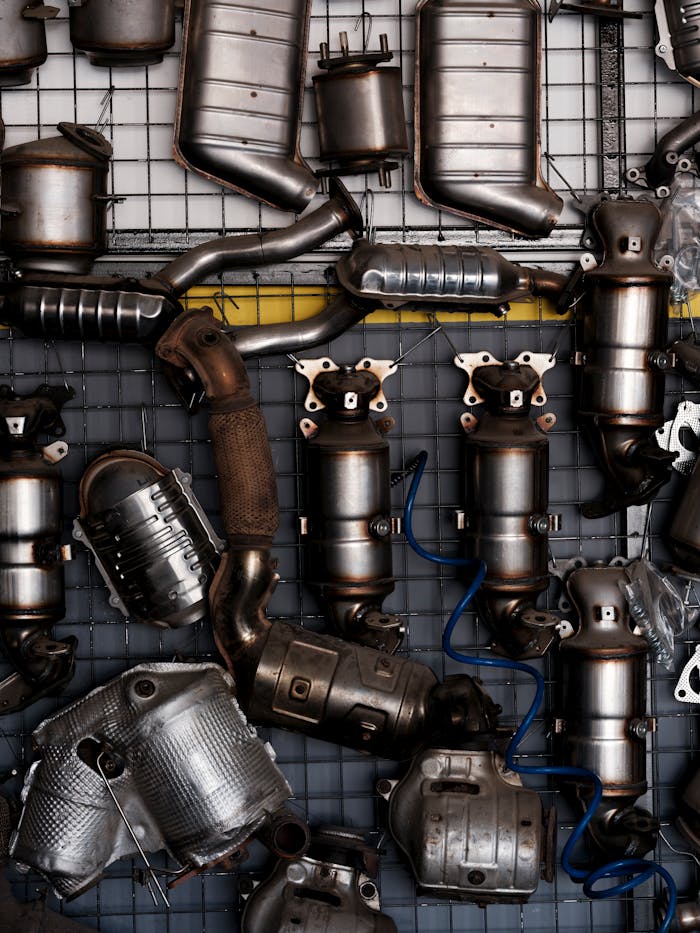
Catalytic converters are priced on their content of platinum, palladium and rhodium — the platinum-group metals (PGMs) in the ceramic or metallic substrate. A converter is worth far more than the steel around it, and different converters vary widely in value. Never cut converters off and toss them in the exhaust pile. Keep them in a locked or supervised area, record where each came from (the vehicle/work order), and keep them intact — a cut-open or emptied converter loses most of its value and raises red flags. See sell catalytic converters and our guide to catalytic converter scrap value in Ontario.
2. Aluminum wheels (A356 alloy)
Most alloy wheels are cast from A356 aluminum. They’re one of the most valuable scrap streams a tire shop has, but only if they’re prepared properly: tires off, wheel weights removed, valve stems and TPMS sensors pulled. Chrome-plated and heavily painted wheels are graded differently, so keep chrome rims in their own stack. Details: scrap alloy rims and wheels and scrap rim prices: aluminum vs steel.
3. Copper and brass
Copper is the most valuable common scrap metal in a shop, and the easiest to lose in the wrong bin. Keep at least three small containers:
- Clean copper (#1): bare, shiny, unpainted wire and pipe with no solder or fittings.
- Dirty copper (#2): soldered, painted, tarnished or with small attachments.
- Yellow brass: fittings, valves and hardware. Don’t mix it with copper.
Insulated wire and wiring harnesses can go in their own bucket. Never burn insulation off wire.
4. Radiators and AC condensers
Copper/brass radiators (older vehicles, heavy trucks, equipment) and aluminum radiators with plastic tanks are graded separately. Aluminum AC condensers and heater cores also deserve their own pile. Drain coolant first.
5. Alternators, starters and electric motors
These contain copper windings in a steel or aluminum case. They’re their own category — not clean copper, not steel. One box or tote is enough. If you send cores back to suppliers, keep core returns physically separate from scrap so nobody mixes them up. More on parts: sell scrap car parts.
6. Cast aluminum
Transmission cases, intake manifolds, cylinder heads, housings and brackets. Drain fluids. Steel inserts are fine but lower the grade; pull what’s easy.
7. Brake rotors and drums (cast iron)
The volume stream. Rotors and drums are grey cast iron. Keeping them separate from light mixed steel usually lets them grade as cast iron, which tends to be better than lumping everything into one steel pile. Pull pads and clips where it’s easy.
8. Stainless steel
Muffler shops doing custom stainless exhaust should keep stainless offcuts and replaced stainless sections separate. Stainless is often non-magnetic (or weakly magnetic), so label the bin clearly.
9. Lead-acid batteries
Upright, intact, on a pallet or in a battery tray, away from drains. Cracked or leaking batteries stored separately and flagged when you book.
10. General / mixed steel
Everything magnetic that isn’t cast iron: brackets, exhaust pipe, steel rims, springs, sheet metal, old tools. This is your catch-all.
The magnet rule
Hang a strong magnet on a string by the sorting area. Rule for every tech: if the magnet doesn’t stick, it doesn’t go in the steel bin. That one habit catches most of the value that leaks out of shop scrap.
Want a scrap program set up for your shop? Call EcoScrap.
Free pickup within 200 km of Toronto · Cash paid on the spot
📞 Call (647) 915-5440 NowHow to set up your sorting and storage area
A good scrap area is close to where the scrap is made, easy to load from, and impossible to misunderstand. Here’s a layout that works for most shops.
Choose the location
- Near the bays, near the door. Ideally between the work area and the exit you’ll load from. Short carry distance means techs actually use it.
- Out of walkways. Never in front of exits, electrical panels, fire extinguishers, eyewash stations or compressor controls.
- Covered if possible. Rain and snow add weight, rust and mess, and water pooling in wheels and drums is a winter hazard. A lean-to, canopy or lidded containers help.
- Accessible to a truck. When we arrive, we want to load quickly without blocking your customers. A spot near a rollup door or an accessible part of the lot is ideal.
Choose your containers
- Pallets for rotors, drums, wheels and batteries. Use sturdy pallets — cast iron is heavy.
- Steel bins or heavy totes for mixed steel and cast aluminum.
- Small buckets or tubs for copper, brass and wire. Small high-value items get lost in big bins.
- Lockable cabinet or cage for catalytic converters.
- Battery trays or a dedicated pallet for batteries.
Label everything
Big, simple labels that a new hire can understand on day one: “ROTORS & DRUMS ONLY,” “ALUMINUM WHEELS – TIRES/WEIGHTS OFF,” “CLEAN COPPER,” “BRASS,” “CONVERTERS – SEE MANAGER.” Colour-coding helps. A one-page laminated guide on the wall by the bins is even better.
Make it part of the workflow
The best scrap programs don’t rely on someone doing a big sort on Friday afternoon. They rely on techs putting each part in the right place at the moment it comes off the car. Build it into the job: when a brake job is done, rotors go straight to the rotor pallet; when an exhaust is replaced, the converter goes to the cage and gets logged.
How often should you schedule scrap pickups?
There’s no single right answer, but there are three good rules.
- Pick up before scrap blocks work. If a pile is starting to crowd a bay or a walkway, you’ve waited too long. Lost bay time is almost always worth more than any market movement.
- Match the rhythm to your biggest stream. A brake specialist producing a pallet of rotors a week wants weekly or bi-weekly pickups. A general shop might be fine monthly.
- Plan around seasons. Tire shops see a surge of damaged wheels during spring and fall changeover. Book an extra pickup at the end of each rush.
Fixed schedule or “call when full”?
- Fixed schedule (e.g., every second Tuesday) works best for busy shops with steady volume. Everyone knows when the truck comes; the area never overflows.
- Call when full suits smaller shops with irregular volume. The trigger is simple: when the rotor pallet or wheel stack is full, call (647) 915-5440.
- Hybrid — a regular monthly visit plus extra calls in busy seasons — is what many shops end up with.
Should you wait for prices to go up?
Scrap prices follow live commodity markets for copper, aluminum, nickel, lead, steel and the PGMs. They move up and down, and nobody can reliably time them. For most shops the cost of storing scrap (space, mess, theft risk, rust, safety) outweighs any gain from waiting. Steady, regular pickups are the low-stress approach.
How EcoScrap pickups work for shops
- Call (647) 915-5440 and tell us about your shop — what you do, what scrap you generate and roughly how much.
- We suggest a rhythm that fits your volume and space, or you choose “call when full.”
- On pickup day, our crew arrives and does the loading. Your techs keep working.
- Each category is weighed and graded separately on site — rotors, wheels, copper, brass, aluminum, batteries, converters and parts.
- You’re paid on the spot. Cash, or e-Transfer if you’d rather have a digital trail for your books.
- You get a record of what was picked up so you can track your scrap income over time.
Pickup is free anywhere within 200 km of Toronto. Learn more on our scrap metal pickup page and in free scrap pickup within 200 km of Toronto.
Book your first shop pickup — free, and paid on the spot.
Free pickup within 200 km of Toronto · Cash paid on the spot
📞 Call (647) 915-5440 NowRecord-keeping: keep it simple, keep it clean
Good records protect your shop, keep your accountant happy, and make it easy to see whether your scrap program is working.
What to record at each pickup
- Date of pickup and who from your shop handed it over.
- Categories and weights (or counts, for converters and batteries).
- Amount paid and method (cash or e-Transfer).
- Any notes — e.g., “extra wheels from fall changeover.”
Catalytic converters need extra care
For every converter, it’s good practice to note the work order or vehicle it came from. This protects you if questions ever come up and shows you’re running a legitimate operation. EcoScrap checks valid government photo ID and records converter transactions as part of responsible buying. We do not buy stolen parts.
Cash handling
If you take cash, decide who in the shop is allowed to receive it, record it the same day, and deposit or log it in your books. Many owners prefer e-Transfer for exactly this reason — it creates an automatic record. Talk to your accountant about how to treat scrap income for your business; this guide isn’t tax or legal advice.
Track it monthly
A simple spreadsheet with one row per pickup is enough. After a few months you’ll see your average monthly scrap income, which streams pay the most, and whether you’re scheduling pickups at the right rhythm.
| What to track | Why it matters |
|---|---|
| Pickup date | Shows your rhythm; spot gaps where scrap piled up |
| Category weights or counts | Tells you which streams are worth the most effort |
| Amount paid | Your actual scrap income for the books |
| Payment method | Cash reconciliation; e-Transfer creates its own record |
| Converter source (work order) | Responsible, traceable sourcing |
| Notes | Seasonal spikes, special loads, issues |
Safety: protect your team while handling scrap
A scrap program should make your shop safer, not more dangerous. These basics go a long way.
Lifting and handling
- Rotors, drums and batteries are heavy. Lift with legs, not back, and get help or use a cart for heavier pieces.
- Use sturdy pallets and don’t overload them. A collapsing pallet of cast iron can crush a foot.
- Stack heavy items low; never build a tall, unstable pile.
Sharp edges and cuts
- Exhaust pipe, sheet metal, broken wheels and cut parts have sharp edges. Cut-resistant gloves should be standard for anyone handling scrap.
- Keep small sharp pieces in containers, not loose on the floor.
Fluids and environmental care
- Drain engine oil, transmission fluid, coolant and refrigerant-related components properly before parts go into scrap, using approved containers and your usual disposal channels.
- Keep scrap areas away from floor drains where possible.
- AC refrigerant must be recovered with proper equipment by qualified people — don’t vent it.
Batteries
- Store upright, away from sparks and heat.
- Wear eye protection and gloves when handling cracked or leaking batteries.
- Never stack batteries directly on top of each other without a solid layer in between.
Fire and access
- Keep scrap away from exits, fire extinguishers and electrical panels.
- Don’t let oily rags, cardboard or other combustibles accumulate in the scrap area.
- Keep the loading path clear so pickups are quick and safe.
Common scrap mistakes shops make (and how to fix them)
Most of the money that leaks out of shop scrap leaks out through a handful of predictable mistakes. If you fix only these, your program will already be ahead of most shops.
Throwing converters in the exhaust pile
This is the single most expensive mistake. A converter tossed onto a pile of muffler pipe can end up graded as steel, or go missing altogether. Fix: a locked cage or cabinet, a simple log, and a rule that only the service manager handles converters.
Leaving tires on scrap wheels
A tire on an aluminum wheel turns a clean A356 alloy wheel into a lower-grade item and adds a disposal headache. Fix: use the tire machine to strip scrap wheels when the bay is quiet, and knock off the weights at the same time.
One big bin for everything
A single roll-off or pile means everything is graded closer to the lowest-value material in it. Fix: even three extra containers — non-ferrous, wheels and converters — capture most of the value.
Letting scrap pile up for months
Big piles get wet, rusty, mixed up and dangerous. They also take longer to load and grade. Fix: set a rhythm and stick to it.
Mixing core returns with scrap
Alternators, starters, calipers and other parts that you return to suppliers for a core credit should never sit near the scrap bins. Fix: a clearly labelled “CORES – DO NOT SCRAP” shelf, physically separate from the scrap area.
No records
Without records you can’t tell whether the program is working, and cash payments are hard to reconcile. Fix: one spreadsheet row per pickup, filled in the same day.
Getting your team on board
A scrap program only works if the people pulling parts off cars actually use it. A few practical ideas from well-run shops:
- Explain the why. Techs are more careful when they understand that a converter or a clean aluminum wheel is worth far more than a rotor.
- Make it fast. Bins should be closer to the bays than the garbage. If the right bin is a long walk away, parts end up in the wrong place.
- Put one person in charge. A service manager or senior tech who owns the scrap area, books pickups and keeps the log.
- Keep the rules visible. A laminated one-page sorting guide on the wall, with photos if you can.
- Share the results. Some owners put part of the scrap income toward a team lunch or a shop fund. It’s a simple way to make everyone care about getting it right.
- Onboard new hires. Add a five-minute scrap walkthrough to your first-day checklist.
Seasonal planning for Ontario shops
Ontario’s seasons shape scrap volumes, and a little planning keeps your yard under control all year.
- Spring changeover (roughly March to May): tire shops see a wave of damaged winter wheels and curb-rashed rims. Brake work picks up as salt-damaged rotors get replaced. Book an extra pickup at the end of the rush.
- Summer: often the steadiest season for exhaust, AC and cooling-system work — expect more radiators, condensers and compressors. A good time to clean out the yard and reset your bins.
- Fall changeover (roughly October to December): another wheel surge for tire shops, plus pre-winter brake and battery work. Plan pickups so your yard is clear before snow arrives.
- Winter: road salt across the GTA, Golden Horseshoe and Simcoe County means more rusted exhaust, seized brakes and failed batteries. Keep scrap covered and walkways clear of ice; book pickups on a fixed rhythm so piles don’t freeze into a solid mass.
Tips to get more money from your shop’s scrap
- Separate converters, wheels and copper first — they’re the biggest value leaks.
- Pull tires, weights and valve stems from alloy wheels before stacking.
- Keep rotors and drums apart from mixed steel.
- Use small containers for small valuable metals (copper, brass, wire) so nothing gets lost.
- Drain fluids so parts grade clean and your area stays safe.
- Keep scrap dry where you can — wet, muddy scrap is heavier to handle and messier to grade.
- Train every tech on the magnet rule.
- Book on a rhythm so scrap never piles up into a mixed mess.
- Bundle everything into one pickup. EcoScrap buys scrap metal, converters, rims, parts and even junk cars in one visit.
- Review your records monthly and adjust your sorting to focus on what pays.
Who we work with
EcoScrap works with:
- Mechanic and auto repair shops — independent garages, franchise service centres and specialty shops.
- Tire shops — independents and multi-location tire retailers.
- Muffler and exhaust shops — including custom stainless exhaust fabricators.
- Body and collision shops.
- Dealership service departments.
- Fleet operators — delivery, trucking, municipal, construction and rental fleets.
- Private car owners with junk cars or large loads — see how to sell a junk car in Ontario.
Where we offer shop scrap pickups
We’re based in Toronto and offer free pickup within about 200 km. That includes:
- Toronto: Toronto, Etobicoke, North York, Scarborough
- Peel: Mississauga, Brampton, Caledon, Bolton
- York: Vaughan, Markham, Richmond Hill, Newmarket, Aurora, Stouffville, King City
- Halton: Oakville, Burlington, Milton, Georgetown, Halton Hills
- Durham: Ajax, Pickering, Whitby, Oshawa, Bowmanville, Clarington, Uxbridge
- Hamilton & Niagara: Hamilton, St. Catharines, Stoney Creek, Grimsby, Niagara Falls, Welland
- Waterloo Region & Wellington: Kitchener, Cambridge, Guelph, Waterloo, Fergus
- Simcoe County: Barrie, Innisfil, Bradford, Alliston, Orillia, Collingwood, Wasaga Beach
- Further out: Peterborough, Brantford, London, Port Hope, Cobourg, Lindsay, Woodstock, Stratford, Simcoe, Orangeville
See all our services or contact us to book.
Why shops choose EcoScrap
- Free pickup anywhere within 200 km of Toronto.
- We do the loading — your techs stay on billable work.
- Cash on the spot, or e-Transfer if you prefer.
- Each category graded separately in front of you.
- One buyer for everything — scrap metal, catalytic converters, rims and wheels, car parts and junk cars.
- Flexible scheduling — fixed rhythm, call when full, or a mix.
- Responsible buying — valid government photo ID required, converter and vehicle transactions recorded, no stolen parts.
Turn your shop’s scrap into monthly cash. Call today.
Free pickup within 200 km of Toronto · Cash paid on the spot
📞 Call (647) 915-5440 NowA sample one-month scrap routine for a busy shop
To make this concrete, here’s how a typical general repair shop might run its program in a month. Adjust to your volume.
- Daily: techs drop parts in the right bin as they come off the car. Converters go to the cage and are logged against the work order.
- Weekly: the service manager does a two-minute walk-through. Anything in the wrong bin gets moved. Batteries get checked for leaks.
- Every second week: pickup for rotors, drums and mixed steel if volume is high — or simply when the rotor pallet is full.
- Monthly: full pickup of everything — wheels, copper, brass, aluminum, radiators, alternators, starters, batteries and converters. Payment recorded the same day.
- End of month: one line in the spreadsheet per pickup; quick review of what paid best.
Frequently asked questions
How much can a shop make from scrap each month?
It depends on your volume, what you separate, and live metal prices. Shops that separate converters, wheels, copper and cast iron typically see the best results. Call (647) 915-5440 for today’s prices on your mix.
Do I need to sort before EcoScrap arrives?
No — we take mixed loads and sort on site. But separating high-value items in advance usually increases your payout.
How often should my shop schedule pickups?
Busy brake and exhaust shops often book weekly or every two weeks; general shops monthly; tire shops monthly plus extra pickups after seasonal changeover. Book before scrap blocks your work area.
Is pickup really free?
Yes. Pickup is free anywhere within 200 km of Toronto, and we do the loading.
How do you pay?
Cash on the spot after weighing and grading, or e-Transfer if you prefer a digital record.
What should I do with catalytic converters?
Keep them intact and separate, ideally locked up, and note which vehicle or work order each came from. They’re priced on platinum, palladium and rhodium content.
Should I remove tires from scrap rims?
Yes. Removing tires, wheel weights and valve stems lets aluminum wheels grade as clean alloy wheels, which pays better.
What ID do you need?
Valid government-issued photo ID. Converter and vehicle transactions are recorded, and junk cars require the signed-over ownership permit.
Can you supply bins for my shop?
Tell us your volume and space when you call and we’ll discuss the most practical container setup for your location.
Do you also buy used car parts and junk cars?
Yes — engines, transmissions, alternators, starters, radiators, AC condensers, batteries, exhaust and whole junk cars, all in the same pickup.
Which areas do you cover?
Toronto, the GTA and anywhere within about 200 km, including Hamilton, Barrie, Kitchener, Guelph, St. Catharines, Oshawa, Peterborough, Brantford and London.