
Mechanic Shop Scrap Pickup in Toronto & Ontario – Free Pickup Within 200 km, Cash on the Spot
EcoScrap.ca buys mechanic shop scrap from auto repair garages, muffler and exhaust shops, body shops and dealership service departments. Converters, rotors, alternators, starters, radiators, exhaust, batteries, aluminum and whole cars — we load it all, pick up free within 200 km of Toronto and pay cash on the spot.
Free Shop Scrap Quote
EcoScrap.ca runs a mechanic shop scrap pickup service for auto repair garages, muffler and exhaust shops, body shops and dealership service departments across the GTA and anywhere within 200 km of Toronto. We buy catalytic converters, brake rotors and drums, alternators, starters, radiators, exhaust, batteries, aluminum parts and whole junk cars, load everything ourselves and pay cash on the spot. Call (647) 915-5440 to book a pickup or get today’s price.
Shop scrap is part of Ontario’s wider recycling system: see the Canadian Association of Recycling Industries and Ontario’s Strategy for a Waste-Free Ontario.
What Is Mechanic Shop Scrap Pickup?
Mechanic shop scrap pickup is a simple arrangement: your shop sets aside the metal and parts it removes from customer vehicles, and we come to your bay door to grade it, load it and pay for it. No trips to the scrapyard, no waiting at a scale, and no tying up a tech or a truck for half a day.
Every repair shop produces scrap whether it plans to or not. A brake job leaves rotors. An exhaust job leaves pipes, mufflers and sometimes a catalytic converter. A charging-system repair leaves an old alternator. Over a week or a month, that pile turns into real value sitting in the corner of the shop.
The problem is that most shops treat scrap as an afterthought. It gets thrown into one bin, hauled away by whoever shows up, and nobody really knows what it was worth. Our goal is to turn your mechanic shop scrap into a clean, predictable side income with proper records and zero hassle.
Who We Buy From
We work with every kind of automotive business that pulls parts off vehicles. If you turn wrenches for a living, your mechanic shop scrap has value and we want to buy it. Typical sellers include:
- Independent auto repair shops – general repair, brakes, suspension, engine and electrical work.
- Muffler and exhaust shops – pipes, mufflers, resonators, flex pipes and catalytic converters.
- Body shops and collision centres – damaged aluminum panels, bumper reinforcements, wheels, radiators and AC condensers.
- Dealership service departments – warranty and customer-pay parts, core returns that were not sent back, and trade-ins that are not worth reconditioning.
- Tire shops – steel, alloy and chrome rims (see our tire shop scrap pickup page).
- Fleet operators and quick-lube centres – batteries, rotors, drums and any parts from scheduled maintenance.
Private car owners with a single junk car are welcome too, but this page focuses on the needs of commercial shops that generate scrap every week.
What Mechanic Shop Scrap Do We Buy?
The short answer: nearly every metal part your techs remove. The table below shows the most common categories, what drives the value of each, and how we recommend storing it until pickup day.
| Scrap item | Main material | What drives value | Storage tip |
|---|---|---|---|
| Catalytic converters | Steel shell with platinum, palladium and rhodium coating | OEM vs aftermarket, stamped code, size, core condition | Keep whole, don’t cut open, tag with vehicle if known |
| Brake rotors and drums | Cast iron | Weight and cleanliness | Separate bin, no pads or hardware if possible |
| Alternators and starters | Steel, copper windings, aluminum housing | Copper content, size, completeness | Keep whole in a dry tote |
| Radiators and AC condensers | Aluminum (sometimes copper/brass) | Clean aluminum vs plastic tanks, older copper/brass cores | Drain fluids, keep separate from steel |
| Exhaust pipes and mufflers | Steel and stainless steel | Weight, stainless content | Stack or bin outside |
| Car batteries | Lead and acid | Count and condition (not cracked) | Upright on a pallet, never stacked loose |
| Aluminum parts | Cast and extruded aluminum (e.g. A356 alloy wheels) | Clean vs dirty aluminum, attachments | Separate from steel; remove steel inserts when easy |
| Engines and transmissions | Cast iron, aluminum, steel | Block material, completeness | Drain oil, keep on a skid |
| Whole junk cars | Steel, aluminum, converter, parts | Weight, converter, wheels, reusable parts | Have the ownership ready |
Not sure where something fits? Snap a photo and call (647) 915-5440. We’ll tell you whether we buy it and how to sort it.
Got a Pile of Shop Scrap? We’ll Pick It Up Free
Free pickup within 200 km of Toronto · Cash paid on the spot
📞 Call (647) 915-5440 NowCatalytic Converters: The Most Valuable Mechanic Shop Scrap
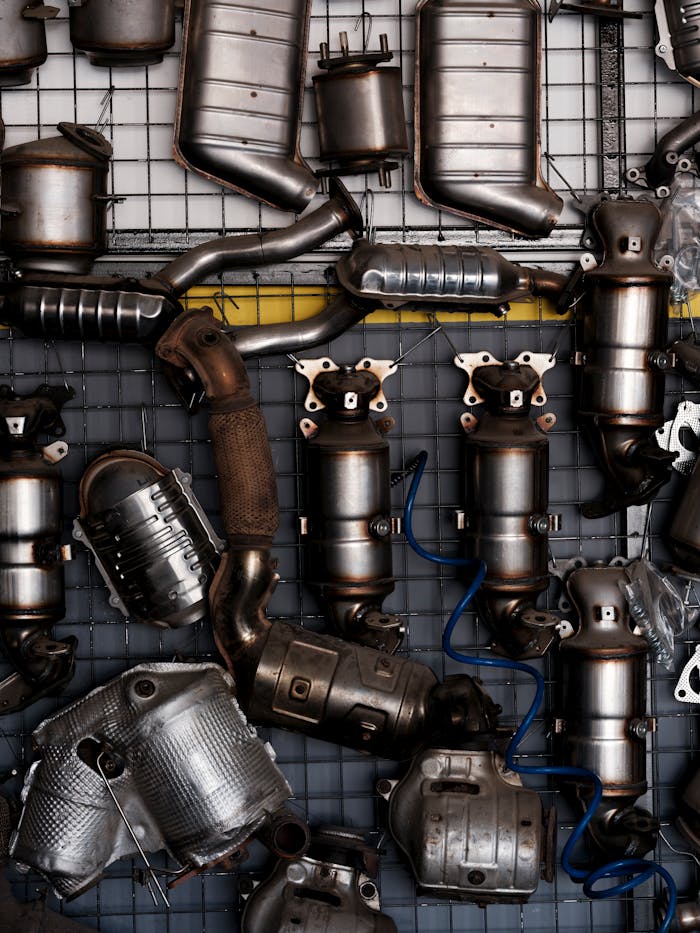
For most garages, catalytic converters are the single most valuable piece of mechanic shop scrap. Each one contains small amounts of the platinum group metals platinum, palladium and rhodium, which are coated onto a ceramic or metal honeycomb inside the steel shell.
The value of a converter depends heavily on what it came off. Original equipment (OEM) converters typically carry far more precious metal than aftermarket replacements. Diesel oxidation catalysts, hybrids and some larger trucks can be different again. That’s why we grade every converter individually by its stamped code, type and condition.
Tips for Shops Handling Converters
- Never cut converters open or remove the honeycomb. Gutted shells are worth only scrap steel.
- Leave a short stub of pipe on each side; we can deal with extra pipe.
- If you know the year, make and model a converter came from, write it on the shell with a paint marker.
- Keep converters indoors or in a locked cage. They are a theft target.
Converter prices follow global PGM markets, so they move regularly. For a full breakdown, read our sell catalytic converters page and our guide to catalytic converter scrap value in Ontario.
Brake Rotors, Drums and Other Cast Iron
Brake jobs are the bread and butter of most repair shops, which makes cast iron rotors and drums one of the highest-volume types of mechanic shop scrap. Individually they are not worth much, but a shop doing several brake jobs a day can fill a large bin quickly.
Cast iron is a ferrous metal, priced by weight. Clean rotors and drums with the pads, clips and hub hardware removed are the easiest to grade. Rotors with bearings and hubs still attached are still fine; just let us know so we can sort them correctly.
Learn more on our dedicated scrap brake rotors and drums page.
Alternators, Starters and Electric Motors
Alternators and starters contain copper windings, steel and aluminum housings. They are graded as “electric motors” or “units” in the scrap trade. Because they hold copper, they are typically worth more per kilogram than plain steel.
Many shops send core units back to their parts supplier for a core credit. Anything that doesn’t qualify for a core return, or that a customer didn’t want back, is perfect for our pickup. We also buy power steering pumps, AC compressors, blower motors and window motors.
Radiators, AC Condensers and Heater Cores
Modern radiators are mostly aluminum cores with plastic end tanks. Older vehicles and heavy trucks may still have copper and brass radiators, which are worth more. AC condensers are typically all-aluminum. Heater cores can be aluminum or copper/brass.
Please drain coolant before setting radiators aside, and keep them separate from steel. If you have true copper/brass radiators, keep those separate too. See our sell scrap copper and brass page for how we grade #1 copper, #2 copper and yellow brass.
Exhaust Pipes, Mufflers and Stainless
Muffler and exhaust shops produce a steady stream of steel pipe, mufflers, resonators and flex sections. Most of it is ordinary steel, but some aftermarket and OEM systems use stainless steel, which is graded separately.
Muffler shop scrap is one of our core specialties. We’ll pick up the pipe pile, any separated stainless and, most importantly, the converters, all in one trip. If you run an exhaust shop, ask about a regular muffler shop scrap schedule.
Car Batteries
Lead-acid batteries are worth money as scrap because of their lead content. They must be stored and transported carefully: upright, on a pallet or in a battery tote, with no cracked cases leaking acid.
We pick up batteries alongside your other mechanic shop scrap. Read our car battery recycling page for safe storage tips and what we accept.
Aluminum Parts and Wheels
Aluminum shows up everywhere in a modern repair shop: control arms, knuckles, intake manifolds, transmission cases, bumper reinforcements, hoods and alloy wheels. Clean aluminum is worth more than aluminum with steel bolts, bushings or rubber attached.
Alloy wheels, often cast from A356 aluminum alloy, are graded on their own. Curb-rashed, cracked and bent rims are all fine. See scrap alloy rims and wheels and our article on scrap rim prices for aluminum vs steel.
Engines, Transmissions and Larger Components
Seized engines, blown transmissions, differentials and transfer cases all have value as scrap. Aluminum blocks and transmission cases are worth more than cast iron, and complete units are easier to grade than ones that have been partially stripped.
Please drain oil and fluids before pickup and keep larger components on a skid or pallet so we can load them safely. For more detail, see sell scrap car parts.
Whole Junk Cars Left at Your Shop
Every shop has one: a car whose owner decided the repair wasn’t worth it, or a vehicle left behind after an estimate. If the owner signs the ownership over, we buy whole junk cars and tow them away free.
The registered owner must sign the vehicle portion of the ownership permit, and the seller must show valid government photo ID. Plates stay with the owner. Our cash for junk cars page and guide on how to sell a junk car in Ontario explain the process.
Turn Your Mechanic Shop Scrap into Cash Today
Free pickup within 200 km of Toronto · Cash paid on the spot
📞 Call (647) 915-5440 NowHow Our Mechanic Shop Scrap Pickup Works
We designed our process around how busy shops actually operate. No paperwork headaches, no hours lost, and payment the same day.
- Call (647) 915-5440. Tell us roughly what you have: converters, rotors, units, aluminum, batteries, cars.
- Get a quote. We explain today’s pricing based on current metal and PGM markets. Photos or converter codes help.
- Book a time. Same-day or next-day pickup is often available. Pick a time that avoids your busiest hours.
- We arrive and load. Our crew sorts, weighs or counts, and loads everything ourselves. Your techs stay on the clock for customers.
- Show ID and sign. The person selling shows valid government photo ID. We record converter and vehicle transactions.
- Get paid on the spot. Cash at pickup, or Interac e-Transfer if your books prefer it.
Scheduled Pickups for Busy Shops
One-off pickups are fine, but most commercial customers prefer a routine. With scheduled mechanic shop scrap pickup, we show up on a set day, weekly, every two weeks or monthly, depending on how fast your bins fill.
Benefits of a Regular Schedule
- Your bins never overflow into the parking lot or bays.
- Converters don’t pile up and become a theft risk.
- Staff know exactly when to sort and stage scrap.
- You get steady, predictable scrap income instead of one big unpredictable load.
You can also use an on-call model: when your converter cage or rotor bin is full, call or text and we’ll schedule the next available slot. Either way, pickup is free within our service area.
For more on setting up a program, see our article on a scrap program for mechanic, tire and muffler shops.
Recordkeeping and ID: Doing It the Right Way
Responsible scrap buying protects your shop and ours. Catalytic converter theft has been a real problem across Ontario, and legitimate buyers need to know where material comes from.
What We Require
- Valid government photo ID from the person selling, every time.
- Transaction records for catalytic converters and whole vehicles, including the date, items and seller.
- Signed ownership permit for any whole vehicle, signed by the registered owner.
What You Get
- A clear record of what was sold, when and for how much, useful for your bookkeeping.
- Itemized counts for converters and batteries so you can reconcile against jobs.
- The option of Interac e-Transfer, which leaves a payment trail many accountants prefer.
We do not buy stolen parts. If anything about a load doesn’t add up, we won’t take it. That standard is part of why shops trust us with their mechanic shop scrap. This is general information, not legal advice; check with your accountant or the relevant authority about your own obligations.
Auto Repair Shop Scrap Pickup Toronto and Beyond
We offer auto repair shop scrap pickup in Toronto and every surrounding region, with free pickup anywhere within 200 km of the city. That covers the entire GTA and the Golden Horseshoe, including Peel, York, Durham and Halton regions, Hamilton, Niagara, Waterloo Region and Simcoe County.
In the city we serve Toronto, Etobicoke, North York and Scarborough. In Peel we cover Mississauga, Brampton, Caledon and Bolton.
In York Region: Vaughan, Markham, Richmond Hill, Newmarket, Aurora, King City and Stouffville. In Durham: Ajax, Pickering, Whitby, Oshawa, Bowmanville and Clarington.
West of the city we serve Oakville, Burlington, Milton, Hamilton, Georgetown, Halton Hills and Stoney Creek. In Niagara we cover St. Catharines, Niagara Falls, Welland and Grimsby.
Further out we reach Guelph, Kitchener, Waterloo, Cambridge, Brantford, Woodstock, Stratford and London. North and east we reach Barrie, Innisfil, Bradford, Orillia, Collingwood, Peterborough, Lindsay, Port Hope and Cobourg.
Read more about our coverage in free scrap pickup within 200 km of Toronto, or visit our general scrap metal pickup page.
Book Free Shop Scrap Pickup Anywhere Within 200 km
Free pickup within 200 km of Toronto · Cash paid on the spot
📞 Call (647) 915-5440 NowMuffler Shop Scrap: A Closer Look
Muffler shop scrap deserves its own section because the mix is different from a general repair shop. Exhaust specialists handle a high volume of steel pipe and mufflers, but the real value is concentrated in a small number of catalytic converters.
That makes sorting important. When converters are mixed into a steel pile, they’re easy to undervalue or lose. We recommend a dedicated, locked converter bin and a separate open bin or rack for pipe and mufflers.
Typical Muffler Shop Scrap Mix
- Steel exhaust pipe and mufflers (by weight)
- Stainless steel sections and tips (graded separately)
- OEM and aftermarket catalytic converters (graded per unit)
- Diesel DPF and DOC units from trucks and vans
- Hangers, clamps and flanges (mixed steel)
Exhaust shops that keep converters separate and tagged usually get the most accurate grading. Ask us about a regular muffler shop scrap schedule.
Body Shops and Collision Centres
Body shops generate a different kind of scrap. Collision repairs often replace aluminum hoods, fenders and bumper reinforcements, radiators and AC condensers damaged in front-end hits, and wheels bent in curb strikes.
Keep aluminum panels separate from steel panels, and pull plastic trim where it’s quick to do. Damaged radiators and condensers can go together in one aluminum bin. Wrecked vehicles that an insurer or owner has written off can be sold whole if the ownership is signed over properly.
Dealership Service Departments
Dealership service departments produce a steady flow of mechanic shop scrap from warranty work, recalls and customer-pay repairs. They often need tidier paperwork than independents, and many prefer e-Transfer to cash.
We can work around service drive hours, keep pickup out of customer areas, and provide itemized records for converters, batteries and vehicles. Trade-ins that are not worth reconditioning or sending to auction can also be sold whole.
Scrapyard Drop-Off vs Mechanic Shop Scrap Pickup
Many shops have always loaded a pickup truck and driven to the yard themselves. That works, but it carries hidden costs. Here is how the two approaches compare for a typical repair shop.
| Factor | Driving to a scrapyard | EcoScrap pickup |
|---|---|---|
| Staff time | A tech or manager off the floor for hours | Your staff keep working; we load |
| Vehicle use | Shop truck tied up, fuel and wear | No shop vehicle needed |
| Heavy items | Engines, transmissions and batteries are awkward to haul | We bring the equipment and crew |
| Converters | Often sold separately at another stop | Graded on site with everything else |
| Payment | Paid at the scale | Cash on the spot or e-Transfer at your shop |
| Scheduling | Whenever someone has time | Booked or recurring to suit your hours |
For most shops, the time saved alone makes pickup the better choice. The labour hour your tech spends driving to a yard is a labour hour you can’t bill a customer for.
How to Set Up Your Shop for Scrap
A little organization goes a long way. Shops that set up a simple sorting system usually get cleaner grading and faster pickups, and their bays stay safer.
A Simple Bin Layout
- Converter cage: a locked cage or cabinet indoors, ideally near the exhaust bay.
- Cast iron bin: rotors, drums and brake hardware without pads.
- Steel bin or rack: exhaust pipe, mufflers, brackets and mixed steel.
- Aluminum bin: radiators, condensers, wheels, control arms and other aluminum parts.
- Units tote: alternators, starters, AC compressors and motors.
- Battery pallet: batteries upright, in rows, away from drains.
Label each bin clearly so every tech knows where things go. A two-minute walk-through at the end of the day keeps mixed material from building up.
Safety and Fluids
Drain engine oil, transmission fluid and coolant into your normal waste fluid containers before parts go into scrap bins. AC refrigerant must be recovered by someone qualified before compressors and condensers are scrapped. Keep scrap piles out of walkways and away from lifts.
What Should Stay Out of Your Scrap Bins?
Scrap pickups are for metal and auto parts. Please keep used oil and other fluids, hazardous waste and fuel tanks that haven’t been emptied out of your scrap bins. We never accept any part or vehicle without a clear, legitimate source. If you’re unsure about something, such as tires or non-metal items, call first and we’ll let you know.
When Shops Generate the Most Scrap
Scrap volume in a repair shop follows the seasons. Spring and fall tire changeovers bring rim and brake work. Winter brings dead batteries, failed starters and rusted-out exhaust. Pothole season after the thaw brings bent wheels and suspension parts.
Knowing your busy periods helps you plan. Many shops increase pickup frequency during peak months and scale back in quieter ones, so their mechanic shop scrap never gets out of hand. Call (647) 915-5440 and we can adjust your schedule at any time.
Why Sell Your Mechanic Shop Scrap to EcoScrap?
- We come to you. Free pickup anywhere within 200 km of Toronto.
- We do the loading. Your techs stay productive and your bays stay clear.
- Cash on the spot. Or Interac e-Transfer if you prefer.
- One stop for everything. Converters, rotors, units, radiators, batteries, aluminum, exhaust and whole cars in a single trip.
- Fair, market-based quotes. Prices follow live metal and PGM markets; we explain how each item is graded.
- Legitimate and documented. ID and records for every converter and vehicle transaction.
- Fast scheduling. Same-day pickup is often available.
Tips to Get More for Your Mechanic Shop Scrap
The way you sort and store scrap has a direct effect on what it’s worth. These simple habits help shops get the most from every load.
- Separate by material. Keep cast iron, steel, aluminum, copper-bearing units and batteries in separate bins.
- Keep converters whole and secure. Never gut them, and store them in a locked area.
- Tag converters with the vehicle. Year, make and model help grading when codes are worn.
- Drain fluids. Oil, coolant and refrigerant should be properly handled before scrap leaves your shop.
- Strip easy attachments. Pulling steel bolts off aluminum or plastic off radiators upgrades the grade.
- Keep it dry. Units and batteries hold up better under cover.
- Don’t wait too long. Big piles become a theft and safety risk; regular pickup keeps things tidy.
- Call before you sell. Metal and PGM prices move; we’ll give you today’s pricing.
Questions to Ask Any Scrap Buyer
Whether you work with us or someone else, it pays to ask a few questions before you hand over a season’s worth of material. A good buyer will answer all of them clearly.
- How do you grade catalytic converters? Look for per-unit grading by code, type and condition, not a flat price for the whole box.
- Is pickup really free, and what’s the radius? Ours is free anywhere within 200 km of Toronto.
- Who does the loading? If your staff have to load heavy engines and batteries, that’s a cost to you.
- How and when do you pay? We pay cash on the spot or by e-Transfer at pickup, not weeks later.
- What records do you keep? A legitimate buyer asks for ID and records converter and vehicle sales.
- Can you handle everything in one trip? Separate buyers for converters, iron and batteries means more visits and more disruption.
Asking these questions helps you compare buyers on more than just a headline number. The best mechanic shop scrap partner is the one that is fair, consistent and easy to deal with month after month.
Environmental Benefits for Your Shop
Recycling your scrap keeps steel, aluminum, copper, lead and precious metals in use instead of in landfill. Ontario’s waste strategy encourages a circular economy, and auto parts are among the most recyclable products there are.
For many customers, being able to say every metal part is recycled is a real selling point. A documented mechanic shop scrap program supports that message.
Frequently Asked Questions
Do you charge for mechanic shop scrap pickup?
No. Pickup is free anywhere within 200 km of Toronto, and we load everything ourselves.
How do you pay for shop scrap?
We pay cash on the spot at pickup. Interac e-Transfer is also available if your shop prefers it.
What scrap do you buy from mechanic shops?
Catalytic converters, brake rotors and drums, alternators, starters, radiators, AC condensers, exhaust, batteries, aluminum parts, engines, transmissions, rims and whole junk cars.
Can we set up a regular pickup schedule?
Yes. We offer weekly, every-two-weeks, monthly or on-call pickups depending on how much scrap your shop generates.
Do you need ID when we sell?
Yes. The person selling must show valid government photo ID, and we record converter and vehicle transactions. We do not buy stolen parts.
Do you offer auto repair shop scrap pickup in Toronto and the suburbs?
Yes. We cover Toronto, the whole GTA, Hamilton, Niagara, Waterloo Region, Simcoe County and everywhere within 200 km.
Do you buy muffler shop scrap?
Yes. We buy exhaust pipe, mufflers, stainless and catalytic converters, including diesel DPF and DOC units.
How are prices set?
Prices follow live metal and PGM markets. Converters are graded per unit; most other scrap is priced by weight and grade. Call for today’s price.
Can you take a whole car a customer left at our shop?
Yes, if the registered owner signs the ownership permit over. We tow it away free and pay on the spot.
How fast can you pick up?
Same-day or next-day pickup is often available. Call (647) 915-5440 to check timing for your area.
Clear Out Your Shop Scrap Today
Call now for a free quote. Free pickup within 200 km of Toronto, we do the loading, and cash is paid on the spot.